Heat and Dust by Ruth Prawer Jhabvala, UK, 1975
 This fairly slim novel (181 pages), which won the Booker Prize in 1975, is set in the India of the 1920s with a parallel story taking place in the 1970s. The contrasts and the similarities in these two stories are woven together to give an intelligent and extremely observant picture of India in the closing years of Imperialism and India almost three decades after Independence.
In the story from 1923, sheltered, somewhat-spoilt Olivia arrives in India as the young bride of Douglas, an English civil servant. Surrounded by unbelievable poverty and the heat and dust of the title, she is part of the English enclave where English traditions are upheld to the point that if one could remove the heat and the dust one might almost believe that one was still living in England. The Indians are shadowy, background figures who are only there to make life more comfortable for the English rulers. The exception is the Nawab, a minor Indian prince, who, in spite of his being corrupt and completely untrustworthy, offers Olivia some respite from an often-absent husband, loneliness, boredom and even the inhospitable Indian climate.
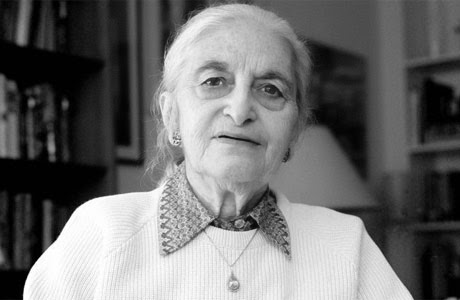
Photo of Ruth Prawer Jhabvala from www.theguardian.com
In the parallel story, in which Olivia’s step-granddaughter comes to India in the early 1970s to try to find out what happened to Olivia all those years ago, the racial tables are turned, although the poverty and the dust and the heat are the same. Apart from the step-granddaughter (whose name remains a mystery) and an Englishman called Chid, who has come to India seeking enlightenment, all the other characters in this story are Indian. The granddaughter, unlike Olivia, is self-assured and independent, but, like Olivia, becomes involved with two men, one from each side of the racial divide. Both women, half a century apart, are plunged into a situation where they must make a difficult choice against the background of racial and social expectations; in the end, it is the country, India, that is the ultimate victor.
There is a restrained, subtle humour throughout the entire book, which is well-written, and the descriptive passages are obviously written by someone who has lived in the country and who has learnt to love it. The excessive lifestyle of the small group of English civil servants is contrasted both with the poverty of the ordinary Indian and with the harsh beauty of the untamed landscape. It is a book about the need to survive, irrespective racial group or social class, in an environment where the country itself always has the highest card.