Bridge of Clay Markus Zusak, Australia, 2018
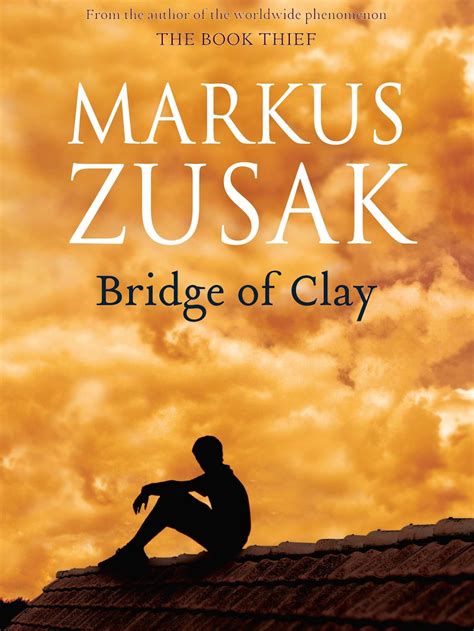
It took me about 60 pages to actually start getting into this book, and even then it was a roller-coaster ride. Putting all of this to one side (for a moment) the language and the visual images are very often unforgettable. Zusak’s descriptions of the Dunbar family, places frequented, things said fill each page with pictures that are candidly real and more than often unapologetically sad. This is not a happy book, but then again, life is often not happy. Though the slivers of light that illuminate the sadness do make the book worth reading.
Artist Michael Dunbar is reduced to a pitiful figure on a garage floor somewhere in Sydney’s west after his wife, Abbey – his muse and his motivation – leaves him for another man. Life for Michael seems to be over, until an unexpected event throws him into the pathway of Polish refugee Penelope and her piano. They marry and move to 18 Archer Street; within a few years the Dunbar family has expanded with five boys: Matthew, Rory, Henry, Clayton (Clay) and Tommy. When Tommy is still in primary school Penny dies of cancer. The dying takes a long time (several years), and Zusak’s telling of this is deeply respectful and emotionally beautiful – in fact it is probably one of the most memorable parts of the book. Afterwards Michael disappears, leaving the five boys to fend for themselves. At this point a menagerie of animals enters the house: a mule, a dog, a cat, a fish and a pigeon; each with a name taken from the Odyssey or the Iliad, Penelope’s favourite books. Clay, obviously in a really bad space, meets Carey, an apprentice jockey. Then, several years later, Michael returns without warning and asks the boys to help him build a bridge.
Although Matthew is the narrator, he remains very much in the background and Clay is, at all times, the main character. This is a story about the deep love, often below the surface, that holds a family together. Love that can be hidden behind coarse language or impetuous, sometimes violent, physical actions. It is about tragedy and the way it must be overcome. It is all about the importance of connection. The book is not (as the American marketing company would have one believe) a book for young adults. Admittedly the main protagonists are teenagers, but the thought patterns and the overwhelming emotional conflicts are not aimed at children.
I believe that Zusak took twenty years to write Bridge of Clay, and I feel that this time span may have impacted the finished book. I don’t mind books where the chronology is split between past and present, but in this book the story seems to incessantly twist back and forwards on itself, delving into new side-stories, regurgitating information that has already been covered, while often jumping ahead of the storyline with information that has no connection to what is happening or what has happened. By not focusing too much on the many changes of direction in the book I was able, eventually, to appreciate it as a whole. The format is a little like a jigsaw puzzle with small blocks of pieces strewn over the table or the floor. Nothing makes a lot of sense until all the pieces are joined together.
The story itself is thought-provoking and often extremely moving while the characters, on the whole, are realistic; however, I am not sure that it needed to be stretched over almost 600 pages.