The Forsyte Saga, John Galsworthy, England
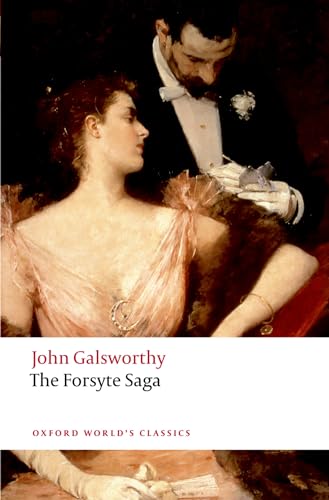
‘A Forsyte takes a practical – one might say a common-sense – view of things, and a practical view of things is based fundamentally on a sense of property’ (Page 131 Heinemann 1976. All quotes are from this edition).
The Forsyte Saga comprises three parts or books. The Man of Property, published in 1906. In Chancery, 1920, and the third book, To Let, 1921. The entire Forsyte Saga centres on Soames Forsyte, who is a proper, upper-middle-class gentleman of the late nineteenth, early twentieth centuries. He regards life through the prism of what he owns; even his wife, the beautiful Irene, is one of his possessions. His emotional development has been hampered by an environment that extols and praises the acquisition of things above all else. He has no time for artists or creative people but he purchases their works of art with a view to making money. He dislikes parting with any of his money, and he wants the best of everything at the lowest possible cost.
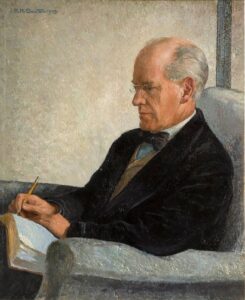
When Soames meets Irene he becomes infatuated, even though the feeling is not reciprocated. Finally, tiring of his determination after eighteen months of courtship, she reluctantly agrees to marry him, but the marriage is understandably unhappy. After a couple of years, Soames decides that it would improve his appearance as a successful man, if he had a house in the country, and that the country air might even have a positive effect on his marriage. He appoints an architect called Philip Bosinney who is engaged to be married to June, a niece of Soames.
Soames looks down on Bosinney (a common creative) while he aspires to get the best house for the least amount of money. The finished house is perfect, but it doesn’t achieve the goal that Soames has set – far from it. In fact, Irene discovers in Bosinney the closeness, the love and the humanity she lacks in her relationship with Soames.
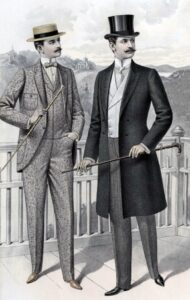
In Chancery begins twelve years after Irene’s affair and its sudden and tragic conclusion. Irene has left her husband and has disappeared, leaving Soames to live the life of a bachelor but without any romantic attachments. Soames never divorced Irene (even though he did have grounds), fearing the impact it would have on his reputation. Then he meets Annette, almost thirty years his junior, and he begins to relish the idea of a son. He soon realises that it is too late to file for divorce on the grounds of his wife being unfaithful more than a decade earlier, but the idea of him putting himself forward as the party at fault is reprehensible to him, and he tries to find another way around the problem.
Although Soames is unlikable in many ways, it is difficult not to occasionally feel sorry for him: he is, after all, the product of a family focused only on money, property and reputation, and he knows no better. His cousin Jolyon (an artist) has, however, managed to extricate himself from the family and what it stands for. Perhaps it is interesting to note that while Jolyon makes art, spurred on by an emotional connection with everything around him, Soames collects art focused entirely on its pecuniary worth.
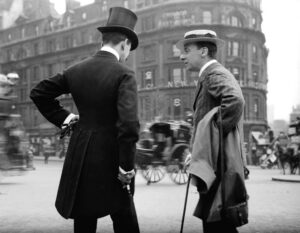
The third book of The Forsyte Saga, To Let, brings the story of the Forsytes to its foreseeable conclusion. Soames Forsyte is now 65 years old, and the ideal on which Soames has built his life and his relationships – that is to say the possession of property – is no longer in fashion. The Great War has upended many ways of thinking: women now have the vote; the ideal is to be doing something, not to be doing nothing; and a man is no longer judged by what he possesses but more by what he stands for and what he does. As one of the characters observes: ‘… the forms of thought change with the times. The pursuit of self-interest is a form of thought that’s going out’ and further: ‘… that the sense of property is dying out’ (503).
Still and all, changes within society have not yet moved beyond the subtle, and even in the early decades of the twentieth century, Soames can still cling to his nineteenth-century beliefs while cars slowly begin to pollute the air and women start to sense freedoms previously not afforded them.
Possession has always been at the centre of Soames’s life, and it is likely that he never understood why Irene did not love him, why she did not want to be viewed as a mere possession, and why she finally left him . But after his cousin Jolyon dies and his sister remarks that he was a very amiable man, Soames begins to suspect that there could be something in the belief that perhaps men are judged by ‘what they were, (rather) than by what they did… ‘ (497). At the very end of the book, Galsworthy writes, regarding Soames: He might wish and wish and never get it – the beauty and the loving in the world. (529)
It is sad that Soames fails to ‘get it’, with the result that his life is just one long disappointment. When Irene looks for love elsewhere, Soames is confounded – after all, he had given her everything. Everything but what she really wanted. Jolyon, on the other hand, understands beauty and love in a way that eludes Soames. Perhaps the only thing that Soames and Jolyon could finally agree upon (from two very different perspectives) was the impossibility of a relationship between their own children.
The writing is at all times beautiful, displaying a delightful sense of humour and an ironic understanding of England’s upper-middle class during the Victorian and Edwardian periods while the attention to detail is to be admired. In the third and final book, Galsworthy paints a thought-provoking picture of England after the First World War as society finally begins to turn its gaze upon itself, and the old set-in-stone beliefs around class, money and possessions are re-evaluated. One hundred years on society is still, to a large extent, focused on the acquisition of property as determining one’s place in society, but we can only hope that women have a slightly better, and more independent, standing than their sisters all those years ago.